


One of the questions my patients ask most frequently about limb lengthening surgery is:
“Doctor, can we lengthen both my upper legs and lower legs at the same time?”
The answer is yes; we call this procedure quadrilateral limb lengthening. However, behind this yes, I have very clear rules centered on patient safety. In this article, I will explain from my own practice how I plan quadrilateral surgery, which patients I perform it on, why I prefer certain combinations, and what you can expect throughout the process.
What Is Quadrilateral Surgery?
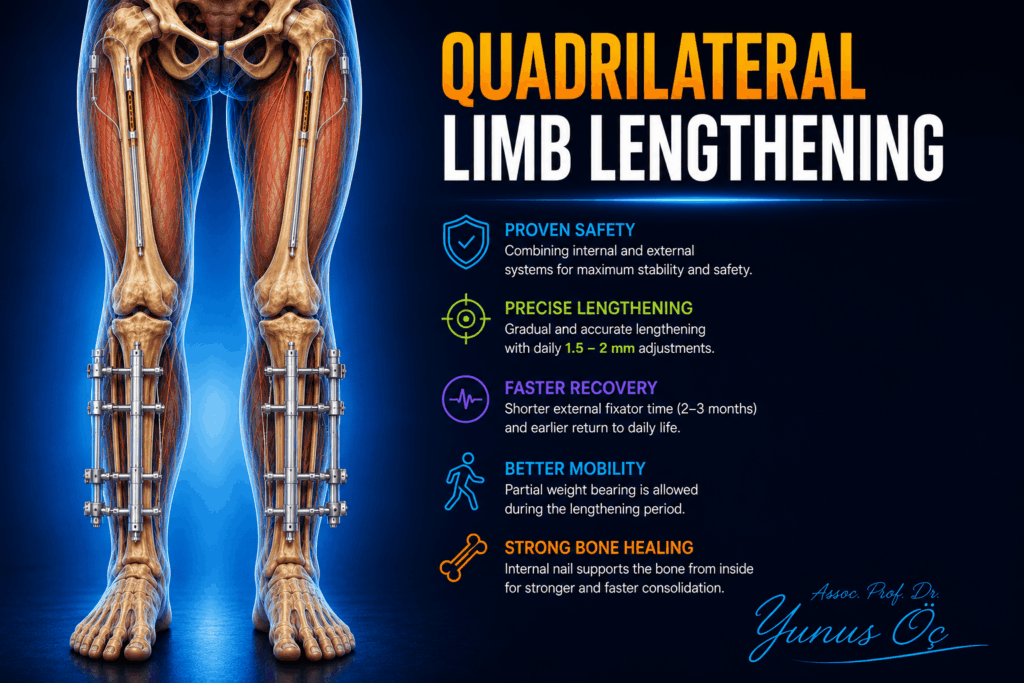
In conventional limb lengthening surgery, we work on a single bone segment: either the upper leg (femur) or the lower leg (tibia). In quadrilateral surgery, however, we cut a total of four bones—the femur and tibia in both legs—in the same surgical session and carry out the lengthening process in all four segments simultaneously.
The main advantage this offers the patient is that the lengthening achievable from a single segment is limited; when two segments are lengthened together, a total gain of up to 12-15 centimeters becomes possible within a single treatment process. Instead of performing two separate surgeries months apart, the entire process is planned at once.
Who Do I Perform It On?
Quadrilateral surgery is not a method I recommend to everyone. During the examination, I assess the following criteria:
Target lengthening amount: If the target is within the safe limit for a single segment, quadrilateral surgery is unnecessary. With a single surgery, we can achieve up to 10 centimeters of femoral lengthening using the Combined/LON method and approximately 8-8.5 centimeters with fully internal systems. If the target exceeds this, we discuss the quadrilateral option.
Bone quality and general health: Simultaneous bone healing in four segments places greater demands on the body than healing in a single segment. Bone mineral density, blood values, and overall health must be suitable for surgery.
Body proportions: During the examination, I measure the torso, upper legs, and lower legs and calculate their proportions. In some patients, lengthening all four segments produces the most natural proportional result, while in others, lengthening a single segment is more aesthetically appropriate.
Psychological preparedness and adherence to the process: Quadrilateral surgery requires more intensive rehabilitation than single-segment surgery. The patient’s informed and willing participation in the process is a prerequisite for success.
How Does the Preoperative Evaluation Work?
I never make the decision to proceed with quadrilateral surgery in a single consultation. The evaluation consists of the following steps:
First, I take a detailed medical history: chronic conditions, medications used, smoking history, previous surgeries, and bone diseases in the family. I then use full-length X-rays of the long bones to assess bone structure and canal diameters and to confirm that the growth plates have closed; nail selection is based on these measurements. Blood tests, an ECG, and an anesthesia evaluation are standard; for patients over the age of 40, I always require a bone mineral density measurement. Finally, I measure height and body segments, calculate proportions, and plan together with the patient how much of the target lengthening will be obtained from each segment
At the end of this evaluation, there are three possible outcomes: quadrilateral surgery is appropriate, single-segment surgery is more suitable, or surgery is not currently recommended. I do not hesitate to state the third outcome; proper patient selection is the most important safety step in this surgery.
The Three Methods I Use: Combined/LON, Fitbone, and Precice 2
Before moving on to quadrilateral planning, let me briefly introduce the three methods that form the building blocks of these combinations.
Combined/LON (Lengthening Over Nail): We place an intramedullary nail in the bone canal and perform the lengthening in daily millimeter increments using an external fixator mounted outside the leg. Once lengthening is complete, I remove the fixator; the nail inside supports the bone throughout the healing process. It is the most economical method and allows up to 10 centimeters of femoral lengthening in a single surgery. In return, an external device must be worn throughout the lengthening period, and the pin sites require regular care.
Fitbone: The lengthening mechanism is located inside the nail; the patient performs the lengthening through the skin using an electronic controller. There are no externally visible components. It offers a major advantage in terms of comfort; its cost is higher than that of Combined/LON.
Precice 2: Like Fitbone, it operates entirely internally; the difference is that lengthening is performed using a magnetic controller. It is the most expensive option among the fully internal systems. With Fitbone and Precice 2, we achieve approximately 8-8.5 centimeters of femoral lengthening in a single surgery.
The lengthening rate and bone healing time are similar for all three methods; the differences lie in comfort, cost, and maximum lengthening capacity. In quadrilateral surgery, I combine these three building blocks according to the rules I will explain shortly.
My Surgical Principle: Why Do I Not Use External Fixators on Both Segments?
I perform quadrilateral surgery using one of two configurations:
First option: The Combined/LON method in one bone segment and a fully internal system (Fitbone or Precice 2) in the other segment. For example, an internal nail in the femur and Combined/LON in the tibia. This combination balances cost and comfort.
Second option: Fully internal systems in both segments. Fitbone + Fitbone, Precice 2 + Precice 2, or a combination of the two. Since there are no externally visible devices, this is the most comfortable form of the process.
I do not apply external fixators to both leg segments at the same time. The reasons for this are well established through experience: for a patient carrying external devices on all four segments, sleeping positions are reduced to almost a single option, movement of the knees, hips, and ankles becomes severely restricted, the risk of infection increases due to the greater number of pin sites, and the burden of the devices slows recovery. Therefore, in my quadrilateral surgeries, at least one of the segments must always be lengthened with a fully internal system. This is a safety rule on which I do not compromise.
How Is the Surgery Performed?
Quadrilateral surgery is performed under general anesthesia. The duration varies according to the selected combination: the Combined/LON + Fitbone combination takes approximately 4.5 hours, while using fully internal systems in both segments (for example, Fitbone + Fitbone) takes approximately 3.5 hours. Because fully internal systems do not require fixator installation, both the surgery and anesthesia times are shorter.
During surgery, I create a controlled cut (osteotomy) in each bone segment and place the lengthening systems. Patients remain in the hospital for an average of 5-7 days after surgery; during this time, pain management and wound care are provided, and the first steps are taken under the supervision of a physiotherapist. My patients generally begin walking with the support of a walker from the second or third day.
The Lengthening Process: How Many Millimeters per Day?
In quadrilateral surgery, we begin lengthening approximately 7 days after the operation. (For single-segment surgeries, this period is 5 days; with four segments, I allow the bones slightly more time to begin the healing process.)
The average lengthening rate in each bone segment is 1 millimeter per day. Because the femur and tibia are lengthened simultaneously, the total daily lengthening per leg reaches approximately 2 millimeters—this is the source of the quadrilateral method’s time advantage. However, this rate is not fixed: I assess new bone formation with X-rays taken every 15 days and, if necessary, reduce the rate or take a short break. The biology of the bone determines the lengthening rate, not the calendar.
The lengthening period generally lasts 1.5-3 months, depending on the target. Physiotherapy is non-negotiable during this period: maintaining the flexibility of the muscles and tendons lengthening across all four segments is the most critical part of the process. The risk of joint stiffness increases significantly in patients with poor adherence to physiotherapy; therefore, I take adherence to the program as seriously as the decision to perform surgery.
Bone Healing and Returning to Normal Life
Once the target lengthening has been achieved, we remove the fixator from the segment treated with Combined/LON; the nail inside the bone continues to provide support throughout healing. Full maturation of the new bone takes 12-15 months, depending on the amount of lengthening.
The transition to walking without support is made gradually according to X-ray findings. A limited return to desk work is possible during the lengthening period; a return to a regular working life generally occurs around the sixth month. Patients may return to light sports within 8-12 months and strenuous sports within 12-15 months, always following an X-ray examination and with my approval.
My approach to nail removal is as follows: Combined/LON nails may be removed if desired. However, I recommend removing Fitbone and Precice 2 nails after healing is complete; because these systems are not fully MRI-compatible, I do not prefer the nails to remain in the body over the long term.
An Example From My Practice
Let me give the example of a patient whose target was 13 centimeters. During the initial examination, the measurements showed that this target could not be achieved from a single segment. Our proportional assessment showed that lengthening both the femur and tibia would produce a natural result, so we planned the process as quadrilateral surgery: a fully internal system in one segment and Combined/LON in the other.
We monitored the lengthening period with X-rays every two weeks; during a period when bone formation slowed, we temporarily reduced the lengthening rate—such adjustments are not a sign of failure, but an indication that the process is being managed correctly. My patient, who adhered closely to the physiotherapy program, achieved the targeted 13 centimeters by the end of the lengthening period; at the end of the bone healing phase, the patient began walking without support and now continues daily life without any limitations.
The point I want to emphasize in this example is that surgery was not the only factor determining the outcome. Proper planning, follow-up every two weeks, and the patient’s discipline in physiotherapy played roles at least as important as the surgery itself.
Let Us Be Honest About the Risks
Quadrilateral surgery is more extensive than single-segment surgery, and challenges such as pain, muscle and tendon tightness, and restricted joint movement are experienced across all four segments. There are three tools for managing these risks: proper patient selection, the correct combination of methods, and disciplined follow-up. My requirement that at least one segment use a fully internal system, my adjustment of the lengthening rate according to the bone, and my X-ray follow-up every two weeks are all parts of this management. In quadrilateral surgeries that are properly planned and followed, my patients achieve their target lengthening and return to their normal lives.
Factors That Accelerate and Slow Recovery
Bone healing is not determined solely in the operating room; the patient’s daily choices directly affect the process.
Smoking is at the top of the list. Nicotine constricts blood vessels and reduces blood flow to the bone; bone healing is significantly slower in patients who smoke, and the risk of nonunion increases. In a surgery such as quadrilateral lengthening, which requires healing in four segments, this effect is multiplied. I ask my patients to stop smoking before surgery and to avoid all nicotine products until bone healing is complete.
Nutrition is the second major factor. Protein, calcium, and vitamin D are required for new bone formation; I check vitamin D levels before surgery and begin supplementation if necessary. We can clearly see the difference in bone healing between patients with balanced nutrition and those with inadequate nutrition on their X-rays.
Sleep and adherence to physiotherapy are the remaining two factors. Bone formation occurs largely during rest; regular sleep is the invisible supporter of the process. Physiotherapy enables the muscles and joints to adapt to the lengthening—I see joint stiffness in patients who neglect the program and a smooth recovery in those who follow it consistently.
Quadrilateral Surgery Prices
The price is determined according to the selected combination of methods. The current quadrilateral package ranges offered by the center I work with are as follows:
Fitbone + Combined/LON: 77.000 – 79.000 USD
Precice 2 + Combined/LON: 80.000 – 82.000 USD
Fitbone + Fitbone: 105.000 – 107.000 USD
Precice 2 + Fitbone: 109.000 – 111.000 USD
Precice 2 + Precice 2: 113.000 – 115.000 USD
These packages include preoperative examinations, operating room and hospital costs, a 5-7-day hospital stay, medications, physiotherapist support, medical equipment such as a walker and crutches, VIP transfers, and, in packages involving Combined/LON, the fixator removal surgery. The exact price is provided as a written quotation following the examination and planning; there are no hidden fees.
Frequently Asked Questions
How many centimeters can I gain with quadrilateral surgery?
By lengthening two segments together, a total gain of up to 12-15 centimeters is possible. We determine your personalized safe target together after an examination and X-ray evaluation.
Which is better: two separate surgeries or quadrilateral surgery?
Both are valid options. Quadrilateral surgery offers a single anesthesia session, one recovery process, and a shorter overall treatment period, while two separate surgeries spread the burden over time. The decision is made according to your health, target, and life plans.
How many hours does the surgery take?
Approximately 3.5 to 4.5 hours, depending on the combination.
Will I be able to walk after four bones are broken at the same time?
Yes. My patients begin walking with the support of a walker a few days after surgery. Assisted walking continues throughout the lengthening period; the transition to walking without support is made gradually as bone healing progresses.
Can I get information about the price?
The package ranges above reflect our current prices; the exact amount is determined after the examination according to the selected combination and personalized plan. You can contact us through the contact page for a detailed quotation.
This article is for informational purposes; an examination is required for personal evaluation and treatment planning.